TL;DR
- Customers don’t care about your internal engagement scores; they care about non-repetitive personalized experiences and attentive interactions with your team members.
- Burnout isn’t fixed by adding apps or retreats; it’s mitigated by subtracting non-valued tasks and cultural friction, recharging the battery by fixing the drains.
- Energy isn’t just a personal responsibility; it requires an intentional design that includes both operational slack and a home system capable of actual disconnect.
Dashboard Delusions
Organizations spend billions globally on engagement platforms, consultants, benchmarks, and the resulting action-planning-and-reporting hours. We chase an index that has only the weakest of ties to actual customer value. We ask employees if they have a best friend at work while they are exhausted barely treading water as our policies, practices, and even our well-intentioned wellbeing apps keep pouring more water in the pool.
The pain point is becoming clear: we are measuring sentiment when we should be measuring capacity. We have spent a decade trying to defeat a negative (burnout) by throwing wellness additives at it. Yet burnout persists. It is time to stop measuring how people feel about the company and start measuring the energy they bring to their work, what provides more energy and what destroys it.
Energy as the Unit of Measure
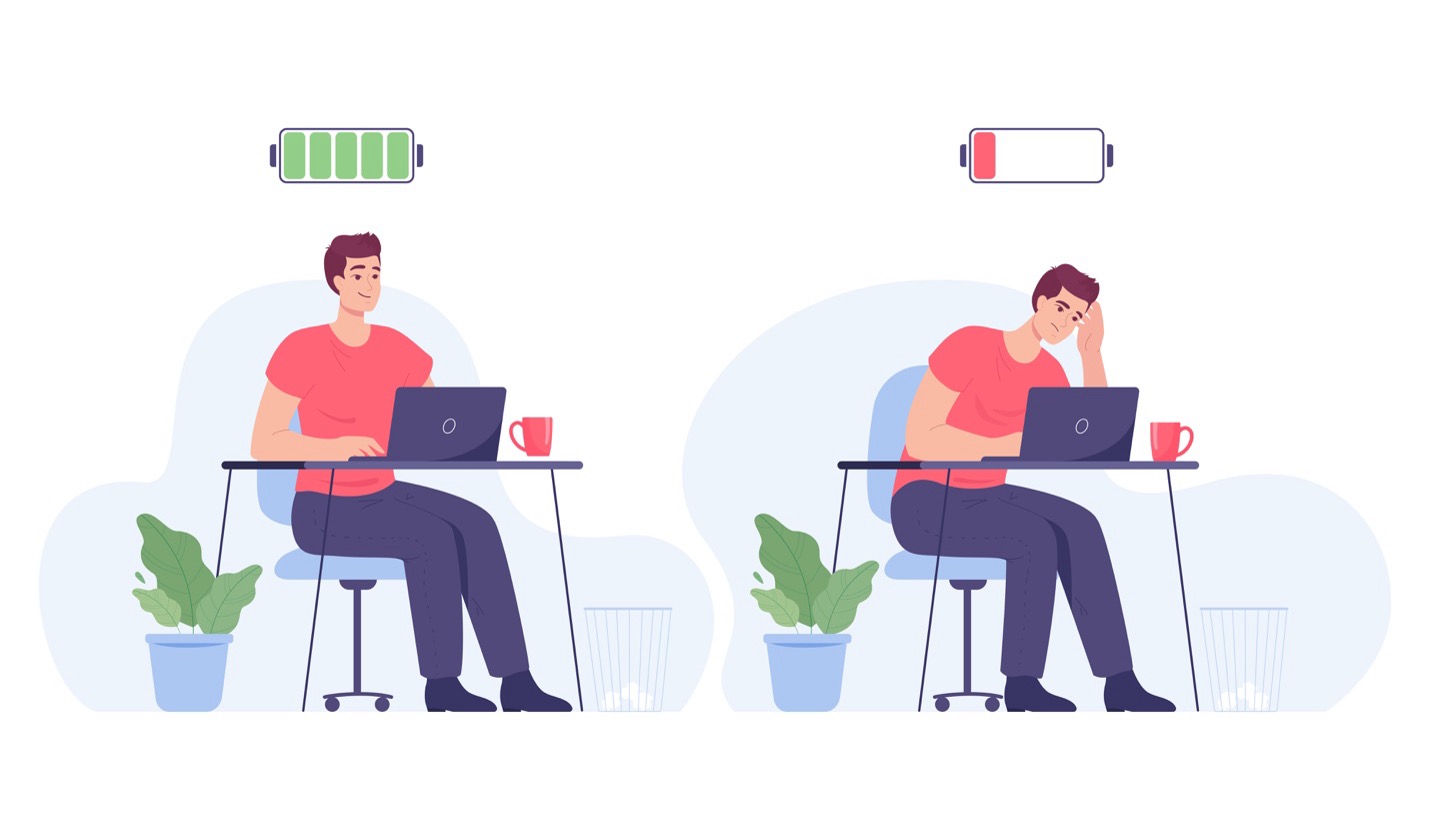
If burnout is the state of your battery being drained, then energy units are the incremental states above and beyond burnout, even sparking inspiration of what a full battery feels like, likely a flow state.
1. The Customer’s View of Your Battery
Let’s start with the only question that matters for durable impact: Do your customers care? A patient in a hospital or a customer in a retail store doesn’t care if a team member is committed to the five-year plan. They care about the energy they bring to their interaction. They want an experience that is simple, non-repetitive, and personalized (“know me, don’t sell me”). According to McKinsey 71% of consumers expect personalization, making them feel special, and 76% get frustrated when this does not occur. To deliver that, your team members need a full battery. If the energy isn’t there, the seamless experience becomes deeply fractured with numerous friction and high-effort points.
2. Reversing Burnout via Subtraction
Burnout is pervasive because our solutions are always additive. We add a mental health app, a weekend retreat, or a reminder to breathe. We have found that the opposite of burnout isn’t wellness, it’s energy. Energy that allows for intention, for deeper interactions and relationships, and for creative solutioning to the hardest problems.
By applying Subtraction Theory, we stop asking what to add and start asking what to remove. According to Gartner, 40% of leader’s time is spent on tasks that should not even exist, draining the cognitive energy they have available. We must identify the energy leaks, the redundant meetings, the manual slop, the friction-filled processes, and challenge all of them. Energy units can be refilled, but only if you stop the leaks first.
3. Designing for Space
Energy doesn’t just happen; it is designed. The clearest example is the Time Away systems. Most organizations encourage time off but fail to design the system to support it.
The work system must have the slack and capacity to allow a member to leave without the work piling up as a re-entry penalty. According to the AMA, 60% of physicians take less than 15 days of PTO a year, of their allocated 35 (on average).
The home system must allow for a true disconnect. That same AMA study said that 70% of physicians reported working during their PTO to avoid the re-entry penalty of an insurmountable inbox.
If the system isn’t optimized for both, vacation is just a change of scenery for your stress and the best PTO benefits in the world won’t solve the real problem. 63% of nurses report losing accrued PTO annually due to the inability to take time away from work. Subtraction is harder than addition, it takes more grit to remove a recurring meeting than to launch an app, but it is the only way to create space for energy to regenerate.
The Message in the Measure
What gets measured gets moved. But more importantly, what you choose to measure sends a signal to your team about what the organization values.
We often assume that well-being is a project that takes years of consistency to fix. Because we view it as a marathon, we justify not starting today or accept years without any change in outcomes. But when we highlight energy as a primary metric, we change the behavior immediately.
Think of the physician staying just well enough to pay the bills, deepening the disconnect with their passion and purpose that brought them through the years of education and experiences in caring for others. An engagement survey asks them if they agree with the Mission Statement. An energy audit asks them what part of their workflow is currently draining their battery. One results in a boardroom slide; the other results in removing a clinical friction point that actually gives them an hour of their life back. Which do you think would make them more engaging to your customers and patients? Where do you want your teams spending their limited resources?
My Perspective
I’ve long believed that, in the fight against burnout, we inadvertently feed it by focusing on the negative. We spend all our time trying to not be tired rather than focusing on what gives our soul energy.
When I reflect on the people I want to work with, or the people I want to buy from, it is always the energy they bring to our interactions. Caring about people isn’t just about paying them or providing benefits; it is about protecting their energy. Sometimes, as a leader, the most caring thing you can do is say no or not now to a new initiative, protecting the slack in the system. Feed the positive, subtract the friction, and the engagement scores will take care of themselves.
About the research
This article explores the Leadership Ridge and the Self Path, using the Behavioral and Systemic View of human capacity. Subtraction Theory, the science of improving systems by removing elements rather than adding them. The Ridgeline Research Graph: Synthesis of energy units, cognitive load, and the burnout-energy spectrum. My experience with the AMA Physician Wellbeing Program and The Science of Flow, which details the environmental factors that can lead to an individual’s flow state.