
TL;DR
- Success isn’t hitting a vacancy or turnover target; it’s ensuring the right human-supply units are consistently available to meet customer demand.
- Labor isn’t just a line-item expense (averaging 10-56% of revenue); it’s a high-yield investment that should be measured by its impact on customer lifetime value and loyalty, not just efficiency.
- Engagement is a vanity metric; the true north star is energy, the physiological and systemic capacity for team members to translate values into the specific behaviors your customers actually care about.
Dashboard Delusions
What does it mean to have a truly successful allocation of human resources? More importantly, how is the return on that investment determined?
A decade ago, HR was a data-poor function. Today, it is drowning. People analytics has become an overwhelming deluge of dashboards, reports, and KPIs. In many cases HR did not choose to spend time on every metric; they inherited them from departments that value tracking of transformation. But in this sea of data, has the function ever aligned on outcomes or evidence of success in the eyes of the customer?
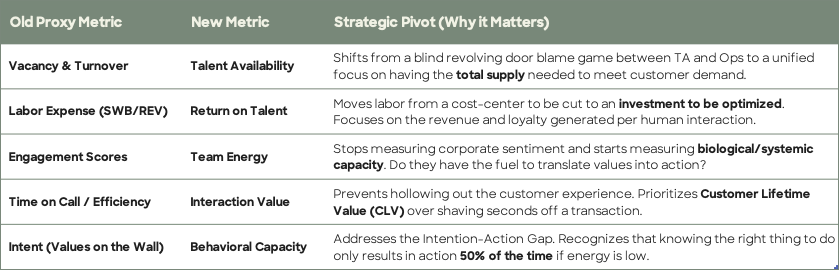
Most rely on proxies: Turnover. Vacancy. Engagement. Looking in the wrong direction has dire consequences. Labor is the engine of the enterprise, accounting for 10-20% of revenue in retail, 20-30% in tech, and a staggering 40-50% (or higher) in healthcare. When you mismanage the measurement of your largest expense, you aren’t just missing a target; your decisions are filled with blind spots, missing growth opportunities. We propose a different starting point, challenging the historic norms of turnover, vacancy, labor expense, and engagement.
1. The Availability of Talent: Supply vs. Demand
The current world of HR is fractured by silos impacted by how we measure at success. We look at a vacancy rate as if it has no relationship with turnover, ignoring the fact that those coming in the revolving door see those going out at the same time. The world is bigger and smaller at the same time, these interactions are seen, posted about and publicly available.
The Conflict: Talent Acquisition (TA) is incentivized by offers accepted, often absolving themselves of candidate quality. Meanwhile, Operations is incentivized to keep them around, often ignoring their recruitment duties that made retention impossible. This is not a people problem but a systemic misalignment of incentives.
The Result: A cycle of finger-pointing: “We can’t get vacancy down because turnover is too high,” vs. “Turnover is high because the new hires aren’t the right fit.”
The Shift: We must focus on the actual unit of human resource available for deployment. By prioritizing Availability of Talent over the siloed proxies of vacancy and turnover, we eliminate the human-slop of internal blame.
How would conversations differ at your organization if these teams were truly rowing in the same direction all the time? If you are leading or apart of these leadership teams, being a great peer leader is essential.
2. Return on Talent: The Value Model
Are your investments in talent creating positive returns, or are you just managing a cost center?
Most organizations focus heavily on SWB/REV (Salaries with Benefits as a % of Revenue). While important for operations, this narrow focus creates unseen opportunities and problems.
The Call Center:
Organizations are currently licking their chops at AI use cases to reduce call center expenses. But they are missing the hidden potential of returns on this talent. What if customer loyalty and experience is significantly impacted by an interaction where a human agent solves a multi-faceted problem that today’s measures don’t capture? Research published in the Harvard Business Review showed that customers with the best experience grew 140% more than those that had a poor experience.
If you measure by Time on Call, you optimize for cost reduction. If you measure by Customer Lifetime Value, you optimize for investment. When we model the positive returns teams create, we stop asking how to cut their budget and start asking how to fuel their growth.
Easier Said Than Done: Modeling, even in the best circumstances, will be flawed in some way. However, co-creation of financial models that create shared understanding and consistent application can change entire perspectives in decision making and internal investment. Would different staffing and support models be considered that could reduce burnout and drive experience? What if models of support were unique to the business or services provided but aligned to a greater formulation of value? Would this approach be both fair, transparent, and aligned to the business, we think so.
3. Energy to do the Right Things: Cultivating the Interaction
Why do we fail to hit the expected value from our teams? Because knowing and doing are two different things. Studies show that good intentions only translate into action about 50% of the time.
We’ve previously made the case for energy over engagement. Here, we take it a step further. If your goal is to optimize the interaction between a team member and a customer, you must ensure the team member has the capability and the capacity to consistently behave in the ways your customers need or desire.
Customer: Can you clearly articulate what your customers want out of an interaction with your organization?
Capability: Do they know the behaviors required to meet those customer interaction needs?
Capacity: Do they have the physical and cognitive energy to bring those behaviors to life in high-stress situations?
By reducing non-value tasks and reinvesting in aligned behaviors, we create the capacity for a culture of showing up for your customers, clarifying what customer-centric really means. This is the heart of both iterative feedback loops and the Subtraction Theory. Having an increasing understanding of customer or team member needs is not enough, your teams need the capacity and neural pathways open to act on those needs consistently.
Escaping the Black Box
The HR industry has decades of dogma, rituals, processes, and consulting models designed to move historical proxy measures. But focusing on these proxies leads to blind spots of lost impact.
If we focus on Availability: Our consultations with Ops managers become proactive demand-planning sessions rather than reactive help wanted requests.
If we focus on Return on Talent: Our conversations with Finance and Growth leaders shift toward unique value models that treat human capital as an asset class.
If we focus on Energy: We move away from pointless engagement scores and toward a model that actually values the team member’s ability to serve the customer.
Measurement is difficult, and over-analysis can lead to paralysis. But we must start somewhere. An Available + Energetic + Valuable model is that starting point.
A Future Perspective
In the not-too-distant future we will reach Level 5 of OpenAI’s 5-Level Framework: the Agentic Organization. Imagine an enterprise where tasks are owned and optimized by a network of AI agents. In this world, the human-led HR function might seem obsolete, but the model actually becomes more relevant. How does the Available + Energetic + Valuable triad hold up in a machine-run world?
Digital Availability: Even today, advanced organizations use allocation agents to govern digital supply. If a customer asks a complex question, the system must ensure the right model, tuned for that specific problem is “available” and online. Governing supply to meet demand is a universal law, whether the unit is a human or a LLM.
Token Value (Return): In a digital org, every interaction token is a cost. However, the future machine won’t just optimize for the lowest cost; it will optimize for the Return on Interaction. If a high-cost, high-reasoning model creates a 10x return in customer loyalty, the value agent will prioritize it over a cheaper, less effective alternative.
Digital Energy (Tone & Latency): What is energy to a machine? It is the processing power, tone, and attentiveness of the interaction. If the system is tired (high latency, low context), the customer disengages. The experience agent ensures the system has the capacity to deliver a nudge or a response that feels empathetic and accurate, if that is what the customer desires.
The Takeaway: A view from the future machine shows us that optimization isn’t about the type of resource (human vs. digital); it’s about the capacity of that resource to create value. If an AI-owned org will be built on these pillars, why are we still measuring our human teams with 1990s-era proxy metrics?
My Perspective
My career started in the depths of the reporting/analytics beast. I’ve seen the lost time, the rabbit holes of useless inquiry, and the dogma of turnover and vacancy. We rarely stop to ask: “Is this moving the needle for our customers?”
Human behavior is innately complex, which is why we retreat to comfortable proxy metrics. But I believe in the power of great intelligence teams. When empowered to be truly unbiased, these teams can strip away the historical slop and show the value of a different, better way. It’s not about having more data; it’s about having the resilience to measure what actually matters.
About the research
This article navigates the Leadership Ridge and the Operational Ridge, synthesizing historical people data with outcome-based modeling. The Ridgeline Research Graph: Measured Outcomes Category for data on labor-to-revenue ratios and metric efficacy. Measure What Matters (John Doerr) on the discipline of aligning OKRs to a North Star. Employee Experience Design (Carter, Gadd, Levy) on shifting the HR operating model from service provider to experience architect and energy. Behavioral Economics in HR: On the 50% gap between intention and action.